The Research Rundown | June 2024
2024-06-05. Published at https://varna.substack.com/p/the-research-rundown-june-edition. This file is a generated copy; the Substack post is the original.
 In Research Rundown - June 2024…
Dear Readers,
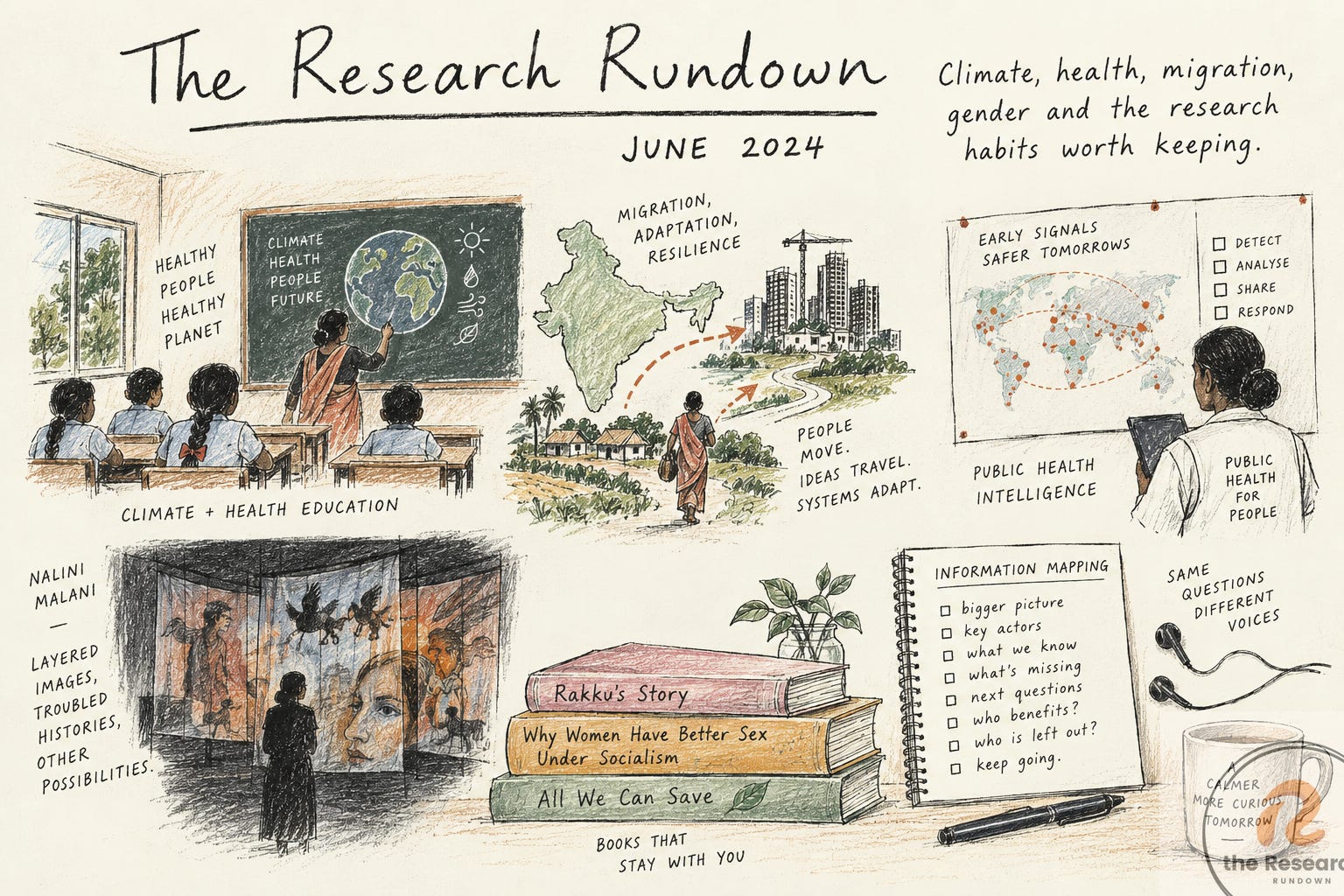
June’s Research Rundown moves across climate education, migration, public-health intelligence, gender, labour and research practice. The geography is deliberately South Asian. The questions are wider.
One thread keeps appearing across these selections: producing evidence is one part of the problem. Schools have to teach it. Governments have to act on it. Researchers have to communicate it clearly. Institutions have to notice who disappears inside an average.
There are papers, podcasts, researchers worth following, a methods corner, a book, some visual thinking and a little silliness.
Read from the top if you like. Skipping around is entirely respectable.
In this issue
- Four papers worth reading
- Podcasts for the commute
- Researchers worth following
- Research praxis: information mapping
- The strange history of the Hawthorne Effect
- A small methods corner
- A visual detour
- One book
- Funsies
Four papers worth reading
Climate change and health belong in the classroom
Ramadani, Khanal and Boeckmann ask what school-based climate education actually teaches children about health. Their scoping review protocol covers primary and secondary education and looks for material on prevention, adaptation, mitigation and the health co-benefits of climate action. Because this is a protocol, it tells us how the review will be conducted rather than what the eventual evidence shows.
The question itself is worth keeping. Climate curricula often explain warming, emissions and environmental damage while giving much less space to heat illness, air pollution, vector-borne disease, food security or mental health. Children encounter climate change partly through their bodies and households. School curricula should recognise that.
Ramadani, Lira, Sudeepa Khanal and Melanie Boeckmann. 2023. “Climate change and health in school-based education: A scoping review protocol.” PLOS ONE 18(3): e0282431.
https://doi.org/10.1371/journal.pone.0282431
How WHO looks for the next public-health threat
Hamblion and colleagues describe the operating machinery behind WHO’s public-health intelligence work: detection, verification, risk assessment, reporting and dissemination. The paper is useful because it makes visible the institutional work between a signal and an international health alert. WHO’s system runs continuously across headquarters and its six regional offices.
Surveillance systems are sometimes discussed as though better data automatically produce better decisions. Verification, triage, judgement and communication sit in between. This paper shows that middle layer unusually well.
Hamblion, Esther, Neil J. Saad, Blanche Greene-Cramer, et al. 2023. “Global public health intelligence: World Health Organization operational practices.” PLOS Global Public Health 3(9): e0002359.
https://doi.org/10.1371/journal.pgph.0002359
South Asia has climate-education policy. Implementation is patchier.
Mbah, Shingruf and Molthan-Hill examine climate-change education across South Asian policy frameworks. Their regional review covers Afghanistan, Bangladesh, Bhutan, India, Maldives, Nepal, Pakistan and Sri Lanka and finds substantial policy recognition through schools, universities, research systems and public-awareness programmes. Implementation is much less consistent, with fragmentation across sectors and weak connections to local adaptation needs.
The regional framing is useful. South Asian countries face different political and institutional constraints, yet several share the same problem: national policy language travels downwards unevenly.
Mbah, Marcellus F., Ajaps Shingruf and Petra Molthan-Hill. 2022. “Policies and practices of climate change education in South Asia: towards a support framework for an impactful climate change adaptation.” npj Climate Action 1: 28.
https://www.nature.com/articles/s44168-022-00028-z
Migration can help households manage climate risk. Access is unequal.
Maharjan and colleagues synthesise evidence from climate-sensitive sites across Bangladesh, India, Nepal and Pakistan. Migration frequently helped households diversify income and spread risk through remittances. The gains depended heavily on who could migrate, the work available at destinations and the resources households already possessed.
The gender finding deserves attention. Migration was frequently male, leaving women with additional agricultural and household work while their authority and access to resources did not necessarily increase at the same rate.
“Migration as adaptation” is therefore too broad to tell us much by itself. The useful questions concern who moves, who stays, who controls remittances and how work is redistributed inside the household.
Maharjan, Amina, Ricardo Safra de Campos, Chandni Singh, et al. 2020. “Migration and Household Adaptation in Climate-Sensitive Hotspots in South Asia.” Current Climate Change Reports 6: 1–16.
https://link.springer.com/article/10.1007/s40641-020-00153-z
Podcasts for the commute
Seema Jayachandran on changing gender attitudes
The IMF’s Women in Economics series has a good conversation with Seema Jayachandran about her research on gender attitudes in Indian schools and conservation incentives in Uganda. It is useful partly because the discussion moves between research design and the policy problem the research is trying to solve.
https://www.imf.org/en/news/podcasts/all-podcasts/2022/11/25/seema-jayachandran
Why women in India are leaving the workforce
This May 2024 episode of Yale’s Voices in Development features Farzana Afridi and Kanika Mahajan discussing the long-running puzzle of women’s labour-force participation in India: rising education alongside persistently low participation in paid work.
The discussion is a useful reminder that labour-force participation rates compress several different processes into one number: care work, marriage, job availability, commuting constraints, household income and the classification of women’s work itself.
Gender and the climate crisis
The Gender & Development podcast with Irene Dankelman and Kavita Naidu examines why climate impacts are gendered and how climate policy can reproduce existing inequalities. The discussion has a strong Asia-Pacific orientation.
https://www.genderanddevelopment.org/283-climate-crisis/
What does AI mean for developing economies?
The World Bank’s June 2024 episode of The Development Podcast looks at AI applications and risks across developing economies, with examples from India, Kenya and Papua New Guinea. The India segment includes education and teacher support.
The episode is useful when read against the tendency to discuss AI almost entirely through high-income labour markets.
Researchers worth following
Shreya Shrikhande
An epidemiologist working on climate change and health, including research from India. Her work is useful for people interested in moving climate-health research from global projections towards local exposure and health-system questions.
Sabyasachi Kar
Based at the Institute of Economic Growth, Kar’s work on political economy, institutions and India’s growth transition remains worth reading, especially alongside accounts that treat the 1991 reforms as a single clean break.
Farzana Afridi
Afridi’s work covers gender, labour markets and human capital in India. Her research on women’s employment is especially useful because it connects household constraints with the structure of labour demand.
Kanika Mahajan
Mahajan works on labour, gender, firms and agriculture. Her work on women’s labour-force participation and gendered employment patterns is worth following for anyone using PLFS or earlier NSS labour data.
Louise Tillin
Tillin’s research on federalism, welfare and Indian politics is useful for development researchers who sometimes treat political institutions as background context rather than part of the explanation.
Kunal Sen
Sen’s work on political economy, structural change and economic growth offers a long-run view of development that is useful when short-run policy debates become too noisy.
Research praxis: information mapping
Evaluation reports often fail for an embarrassingly simple reason. They make the reader work too hard.
Information mapping starts from the assumption that readers need structure before detail. The technique is useful for long evaluations, technical reports, policy briefs and documents written for several audiences.
Start with the decision the report has to support. Build the structure around that.
Keep findings together with the evidence that supports them. Separate description from interpretation. Use headings that tell readers what a section contains. Put methodological caveats where they affect interpretation instead of burying all uncertainty in an annex.
And keep the summary.
A good executive summary is not a ceremonial page placed in front of a report. It should tell a reader what was evaluated, what the evidence permits you to say, what remains uncertain and what decisions follow.
One test I use: give the summary to someone who has never seen the project. If they cannot explain the main findings five minutes later, the problem may be the report rather than the reader.
Robert Horn’s work on knowledge mapping is useful here. His 2001 paper examines large visual maps for complex public problems, where causation, disagreement and institutional responsibilities cannot easily be represented as a tidy linear argument.
Robert E. Horn. 2001. Knowledge Mapping for Complex Social Messes.
https://faculty.washington.edu/farkas/TC510-Fall2011/Horn-SocialMesses.pdf
For a later discussion of his “info-mural” approach:
Robert E. Horn. 2021. “Art + Science + Policy: Info-Murals Help Make Sense of Wicked Problems.” Cadmus Journal 4(5).
https://cadmusjournal.org/article/volume-4/issue-5/art-science-policy
Research history: the Hawthorne Effect
The Hawthorne Effect is one of those research concepts everyone learns and few people revisit.
The label comes from studies conducted at Western Electric’s Hawthorne Works near Chicago in the 1920s and early 1930s. The popular account says worker productivity rose whenever researchers changed working conditions because workers knew they were being observed.
The history is messier.
Steven Levitt and John List recovered and reanalysed data from the original illumination experiments. They found that the familiar claim that productivity rose after virtually every lighting change was not supported by the original data. They did find weaker evidence consistent with observer effects.
The useful lesson survives. Measurement can alter behaviour. The effect should be treated as a hypothesis about a study setting rather than a universal explanation applied whenever participants know researchers are present.
Levitt, Steven D. and John A. List. 2009. “Was there Really a Hawthorne Effect at the Hawthorne Plant? An Analysis of the Original Illumination Experiments.” NBER Working Paper 15016. Published subsequently in American Economic Journal: Applied Economics 3(1), 2011.
https://www.nber.org/papers/w15016
A small methods corner
Odds and likelihood are different things
Odds compare the probability of an event occurring with the probability of it not occurring.
If the probability of an event is pp, its odds are:
p/(1−p)p/(1-p)
Likelihood is a function used in statistical estimation. It asks how compatible observed data are with different parameter values under a specified model.
They sound similar. They do different jobs.
Reach and impact are also different things
Reach describes exposure.
Impact concerns change attributable to an intervention.
A campaign may reach 100,000 people. That number tells us nothing by itself about whether behaviour, knowledge, income or health changed because of the campaign.
Reach is an output measure. Impact requires a counterfactual claim.
This distinction would improve a surprising number of monitoring dashboards.
A visual detour
Nalini Malani’s In Search of Vanished Blood is an immersive moving-image installation that layers drawing, painting, mythology, maps, human figures and women’s voices. The work takes its title from a poem by Faiz Ahmed Faiz and draws partly on Christa Wolf’s Cassandra. M+ holds the 2012 work in its collection.
M+ later commissioned a site-specific version for its enormous façade in Hong Kong, combining live-action performance, animation, drawing, painting and found footage.
See the original work here:
https://www.mplus.org.hk/en/collection/objects/in-search-of-vanished-blood-2019528/
And the M+ façade version here:
https://www.mplus.org.hk/en/mplus-facade/in-search-of-vanished-blood/
Data visualisation people should look at installation art more often. We spend a great deal of time trying to place several layers of information on one flat page. Malani works with image, movement, projection, sound, scale and the viewer’s position at once.
There is something useful there for anyone thinking about how complex information is experienced rather than merely displayed.
One book
Kristen Ghodsee, Why Women Have Better Sex Under Socialism
The title did its marketing job. The more serious argument concerns the relationship between economic systems, social provision and women’s material independence.
Ghodsee draws on her research on women’s lives in Eastern Europe before and after the transition from state socialism. She asks what happens to gender relations when health care, childcare, employment and social security are treated as collective institutions rather than private household responsibilities.
You do not have to accept every part of the argument to find the question useful.
Economic systems enter intimate life through time, money and dependence. That is difficult to see when “the household” appears in economic models as a single decision-making unit.
Publisher page:
Funsies
Why did the researcher bring string to the lab?
To tie up loose ends.
I apologise.
A researcher, an engineer and a mathematician are asked to find the volume of a red rubber ball.
The engineer measures it and applies the formula.
The mathematician constructs the integral.
The researcher searches the literature for “volume of red rubber ball”.
Some jokes survive peer review.
Closing note
This issue began with climate education and ended up moving through migration, gender, surveillance, evaluation writing and statistical language.
That range is intentional.
Development research becomes less useful when our categories become too tidy. Climate shocks alter migration. Migration changes household labour. Household labour is gendered. Gender shapes access to assets and paid work. Public policy measures some of this and misses some of it. Researchers then arrive with instruments designed around the categories we started with.
The circle closes.
The work is to notice where the categories stop matching people’s lives.
See you next time.
Varna Sri Raman Editor, The Research Rundown