The Research Rundown | April 2025
2025-04-28. Published at https://varna.substack.com/p/the-research-rundown-april-2025-edition. This file is a generated copy; the Substack post is the original.
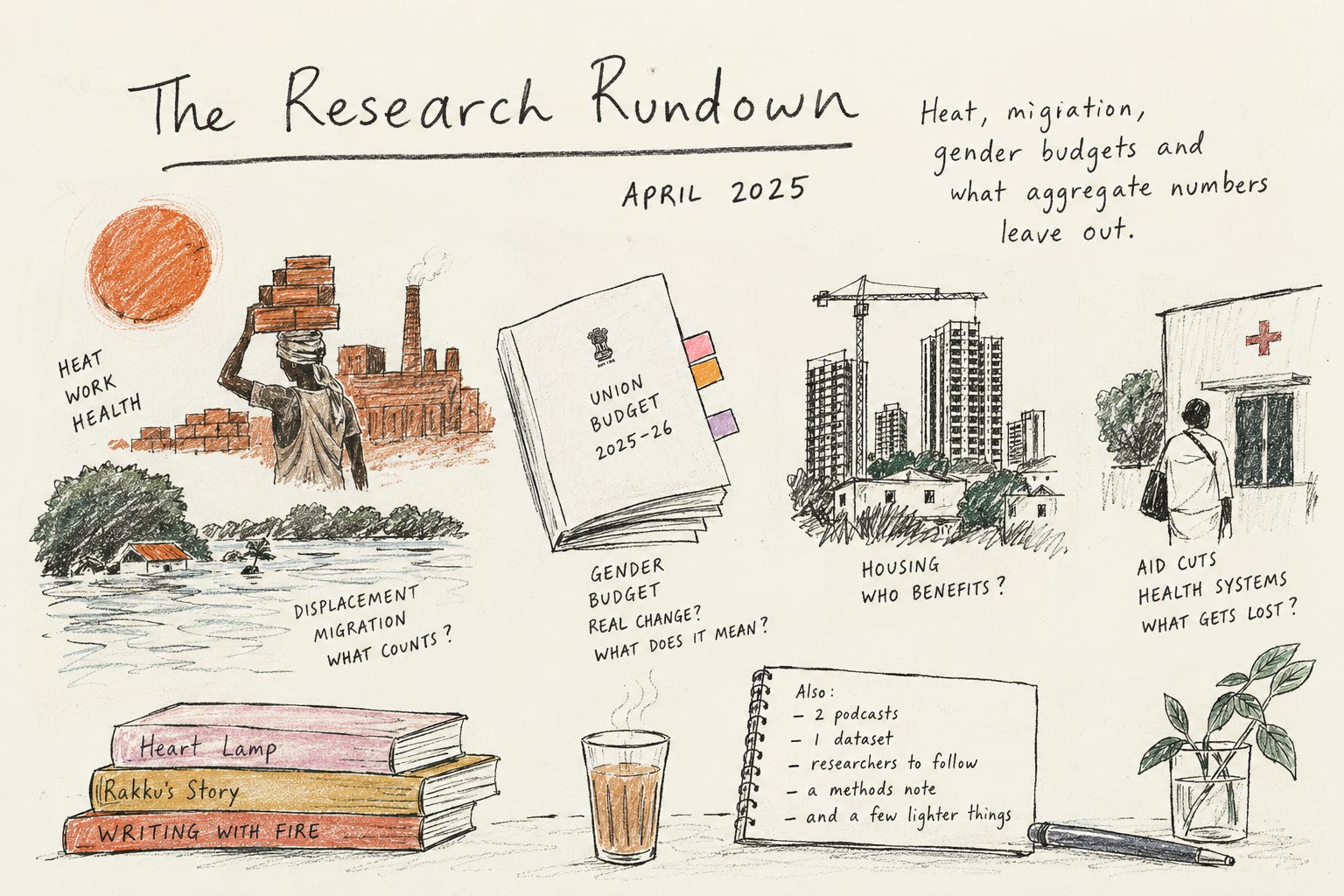
Dear Readers,
The Research Rundown is back.
This issue began with heat. It quickly became an issue about institutions: who is protected when temperatures rise, what happens when environmental shocks push people to move, whether a larger gender budget tells us anything about women’s actual claims on public spending, and what happens to health systems when external financing disappears almost overnight.
There is a recurring measurement problem underneath all of this. National averages are useful. Budget totals are useful. Programme coverage is useful. They become misleading when they are asked to tell us who bears the risk.
There are five readings worth your time, two podcasts, a regional gender resource, researchers to follow, one dataset, a documentary, two books and a methods note.
Skip around.
In this issue
- Five things worth reading
- Podcasts for the commute
- A South Asia resource worth keeping
- Researchers worth following
- One dataset to open
- Research praxis: finding, inference, recommendation
- A documentary
- Two books
- Disambiguation corner
- Funsies
Five things worth reading
Heat is becoming an occupational-health problem for India’s informal workers
The Guardian’s reporting from Indian brick kilns is worth reading alongside the modelling behind it. Brick workers already work beside furnaces in high ambient temperatures, often on piece-rate wages that make stopping expensive. The problem is physiological and economic at the same time.
Research cited in the piece projects rising wet-bulb globe temperatures across India’s brick-producing regions, with substantial increases in the number of days on which physical labour becomes dangerous. India’s brick industry employs millions of workers, many of them migrants and informally employed.
The article is reporting rather than an impact study. It cannot tell us the average health effect across the workforce. What it does show rather well is why advice to “avoid strenuous activity during peak heat” can be meaningless for workers paid by output.
Heat policy needs to enter labour regulation, wage protection and workplace design.
The Guardian, 9 December 2024:
India still has no coherent policy for climate-linked internal displacement
A March 2025 piece in The New Indian Express begins in Bihar’s Kosi region, where repeated flooding has damaged homes, agricultural land and livelihoods. It follows a family forced to move after the September 2024 floods and traces the movement from environmental loss to labour migration.
The article also points to an institutional gap. Two private members’ bills on climate-related displacement were introduced in Parliament in 2022, but neither became law. India still has no national framework specifically governing the protection, compensation or rehabilitation of people displaced by climate-related hazards.
There is a measurement problem here too. “Climate migrant” is not a clean empirical category. Migration rarely has a single cause, and decisions to move can reflect crop loss, debt, employment opportunities, household structure and existing migration networks alongside environmental shocks.
That is a reason for better research, not a reason to ignore the policy gap.
Shubham Thakur, The New Indian Express, 27 March 2025:
India’s gender budget is much larger. The number needs unpacking.
The 2025–26 Gender Budget Statement reports ₹4.49 lakh crore for women and girls, up 37.3 per cent from the previous year’s Budget Estimate. Gender-budget allocations now account for 8.86 per cent of total Union expenditure, compared with 6.8 per cent in 2024–25. Forty-nine ministries and departments and five Union Territories reported allocations, the largest participation since the Gender Budget Statement began.
Those are real changes.
They do not mean that ₹4.49 lakh crore consists of new programmes designed specifically for women. Large existing schemes are classified partly or wholly within the Gender Budget Statement according to the share of expenditure expected to benefit women. PM Garib Kalyan Anna Yojana, PMAY-G and MGNREGS account for a substantial part of the total.
This distinction is central to reading gender budgets. A rising gender-budget number can reflect broader reporting, reclassification or expansion of large universal schemes. Evaluating gender-responsive budgeting requires asking whether expenditure changes women’s access to income, assets, services, safety and public goods.
Government summary:
https://www.pib.gov.in/Pressreleaseshare.aspx?PRID=2098912&lang=2®=48
A useful critical reading by Aishwarya Bhuta:
https://www.policycircle.org/opinion/gender-budget-statement-2025-26/
And ORF’s assessment:
India’s housing boom is increasingly a high-income housing boom
A Reuters poll of property analysts published in December 2024 expected Indian home prices to rise another 6.5 per cent in 2025, following an estimated 7 per cent rise in 2024. Analysts pointed to strong demand at the luxury end of the market alongside worsening affordability for middle- and lower-income households.
Housing-market averages conceal an unusually important compositional shift. Developers can sell more expensive homes to wealthier buyers while the supply problem for lower-income urban residents deteriorates. Rising rents then become part of the same story rather than a separate one.
It is worth resisting the easy claim that rising house prices necessarily demonstrate a healthy urban economy. Prices tell us about demand relative to supply. They do not tell us who can enter the market.
Reuters, 2 December 2024:
Aid cuts are already disrupting health systems
WHO’s April stocktake is the global item I would keep in this issue because the financing shock is large enough to matter directly to South Asian health systems.
WHO surveyed 108 country offices, primarily in low- and lower-middle-income countries, between 7 March and 2 April 2025 following sudden suspensions and reductions in official development assistance for health. Seventy per cent reported disruption to emergency preparedness and response, 66 per cent to public-health surveillance and 58 per cent to service provision. More than 40 per cent reported disruption to health-information systems.
These are reports from WHO country offices, not a representative household or facility survey. WHO itself describes the exercise as a rapid snapshot.
The result is still concerning. Health financing cuts can degrade the systems used to measure their consequences. If surveillance systems, household surveys and routine health information weaken alongside service delivery, deterioration becomes harder to observe precisely when measurement matters most.
WHO, 10 April 2025:
Podcasts for the commute
Why is female employment low in India?
Alice Evans speaks with Suhani Jalota and Lisa Ho on Rocking Our Priors about India’s persistently low female employment and what might change it.
This is worth listening to alongside the endless debate over whether India’s female labour-force participation rate is “really” rising or falling. Measurement matters, especially the treatment of unpaid and subsidiary work. So does the harder question: what forms of paid employment are actually available to women, on what terms, and at what distance from home?
Spotify:
How is climate change affecting motherhood?
The BBC World Service’s The Climate Question speaks with mothers in India, Kenya and the UK about climate change and decisions around pregnancy, children and care.
It is easy to turn “climate anxiety” into a psychological story. The more interesting parts concern material conditions: heat during pregnancy, air pollution, food insecurity, disaster exposure and what parents expect their children’s future environments to look like.
Published 6 April 2025.
Apple Podcasts:
Spotify:
A South Asia resource worth keeping
WEESA
The World Bank’s South Asia Gender Innovation Lab runs the Women’s Economic Empowerment in South Asia Community of Practice, or WEESA.
This is one institutional mailing list I would actually recommend joining. The useful part is the regional evidence base: research, learning events and resources covering Bangladesh, India, Nepal, Pakistan and the rest of South Asia, rather than treating women’s economic participation as an India-only question.
The Gender Innovation Lab itself funds and synthesises impact evaluations and other empirical research on women’s economic outcomes. WEESA is its wider knowledge-sharing community.
South Asia Gender Innovation Lab:
https://www.worldbank.org/en/programs/world-bank-south-asia-region-gender-innovation-lab
WEESA:
https://connect4impact.worldbank.org/organization/womens-economic-empowerment-south-asia-cop
Researchers worth following
Anjal Prakash
Anjal Prakash works on climate adaptation, water, urban resilience and gender in South Asia at the Bharti Institute of Public Policy, Indian School of Business.
A December 2024 PLOS Climate paper of his asks a question that adaptation programmes still handle poorly: have gendered dynamics been adequately incorporated into South Asian adaptation research and practice?
https://doi.org/10.1371/journal.pclm.0000475
In January 2025 he was also selected as a lead author for the IPCC Special Report on Climate Change and Cities.
https://www.isb.edu/news/isb-in-the-news/isb-prof-to-be-lead-author-for-special-un-climate-report
Worth following if you work on climate resilience and find yourself suspicious of adaptation frameworks in which social differentiation appears in the final paragraph.
Navroz K. Dubash
Navroz Dubash’s work on climate governance, energy policy and the Indian regulatory state is useful because it keeps climate politics attached to institutions.
His edited volume India in a Warming World remains a good entry point into the history of Indian climate policy and the relationship between climate action and development.
I would read Dubash particularly when discussions of India’s energy transition become a list of renewable-capacity targets. Transitions occur through electricity regulation, fiscal choices, state governments, distribution companies, coal regions, firms and political bargaining. Technology is one part of that story.
Centre for Policy Research profile and publications:
https://cprindia.org/people/navroz-k-dubash/
One dataset to open
India State of Forest Report 2023
The Forest Survey of India’s India State of Forest Report 2023 is the latest edition available when this issue is being written. It contains state- and national-level data on forest cover, tree cover, mangroves, forest fires, growing stock, bamboo and forest carbon.
The headline forest-cover number is rarely the most interesting part.
“Forest cover” is a remote-sensing classification based substantially on canopy density and land area. It does not by itself distinguish the ecological quality of different forests, nor does an increase in canopy necessarily imply restoration of natural forest. Researchers should read the classification rules before using changes in forest-cover area as a biodiversity outcome.
FSI report portal:
https://www.fsi.nic.in/forest-report-2023
Volume I:
https://fsi.nic.in/uploads/isfr2023/isfr_book_eng-vol-1_2023.pdf
State and Union Territory chapters:
https://fsi.nic.in/isfr-volume-ii
For comparison, PRS’s 2025–26 analysis of the Environment Ministry budget is useful alongside the physical data:
Research praxis
A finding is not an inference. An inference is not a recommendation.
Evaluation reports often move too quickly across these three stages.
A finding might be:
Forty-two per cent of surveyed women reported difficulty reaching the health facility.
The inference could be:
Travel time or transport availability may be constraining service use.
The recommendation might be:
Introduce transport support for antenatal visits.
Each step requires additional evidence.
The survey establishes the reported difficulty. It may support an inference about access, depending on the instrument and sample. It does not automatically establish that transport support is the right intervention, how it should be designed or whether it is cost-effective.
Recommendations become stronger when the report shows the bridge between evidence and action.
For each major recommendation, I find it useful to ask four questions:
- Which finding supports this?
- What causal or institutional assumption connects the finding to the recommendation?
- What evidence supports that assumption?
- What would make the recommendation wrong?
The fourth question is often the most useful.
Documentary
Writing with Fire
Rintu Thomas and Sushmit Ghosh’s 2021 documentary follows journalists from Khabar Lahariya, the rural news organisation led by Dalit women, as its reporters move from print towards digital journalism.
The film is about journalism. It is also about caste, gender, technology and institutions.
One reason it belongs in a research newsletter is that the reporters repeatedly demonstrate something field researchers should recognise. People who live within a political and social setting often know where to look before an outsider has worked out what the relevant question is.
The film was nominated for the Academy Award for Best Documentary Feature.
Official site:
https://www.writingwithfire.in/
Books
Heart Lamp by Banu Mushtaq, translated by Deepa Bhasthi
At the time of this issue, Heart Lamp has just been shortlisted for the 2025 International Booker Prize. It is the first Kannada work to reach the International Booker shortlist.
The collection brings together twelve stories written by Banu Mushtaq between 1990 and 2023 and translated by Deepa Bhasthi. They centre women and girls in Muslim communities in southern India, with caste, religion, marriage, law and family authority running through their everyday lives.
Mushtaq is a writer, lawyer and activist. That matters to the fiction without turning the stories into disguised case studies.
International Booker shortlist, announced 8 April 2025:
Book page:
https://thebookerprizes.com/the-booker-library/books/heart-lamp
From the archive: Rakku’s Story by Sheila Zurbrigg
Published in 1984, Rakku’s Story: Structures of Ill-Health and the Source of Change remains worth revisiting.
Zurbrigg works from the life of Rakku, a Dalit woman in rural Tamil Nadu, to examine illness through labour, nutrition, caste, gender and political economy. The book belongs to an older tradition of social medicine in which poor health is treated as an outcome of material and social relations rather than a collection of individual risk factors.
Some of its language and analytical framing belong to its period. The underlying question has aged rather well: what becomes visible when we begin with a person’s life rather than with the disease category?
Internet Archive record:
https://archive.org/details/rakkusstorystruc0000zurb
Disambiguation corner
Allocation vs expenditure
A budget allocation is what government proposes or authorises to spend.
Expenditure is what is actually spent.
They answer different questions.
A large allocation can indicate political priority, programme expansion or a change in accounting. It does not establish implementation. Actual expenditure can still differ substantially, and expenditure itself does not establish that money produced the intended outcome.
When somebody tells you a programme’s budget increased by 30 per cent, ask which number they are comparing: Budget Estimate, Revised Estimate or Actual Expenditure.
The answer can change the story.
Migration vs displacement
Migration is a broad category covering movement for many reasons and under very different degrees of choice.
Displacement refers to movement in which people are forced or compelled to leave their homes, including because of disasters or conflict.
Climate-related mobility can contain both.
Treating all migration from a climate-stressed region as forced displacement overstates environmental causation. Treating all migration as a voluntary labour-market choice can hide severe constraint.
The categories are analytical tools. People’s lives are less tidy.
Funsies
A qualitative researcher and a quantitative researcher walk into a village.
The quantitative researcher asks, “How many households are there?”
The qualitative researcher asks, “What counts as a household?”
They miss lunch.
This is more realistic than most methods textbooks.
Closing note
Several pieces in this issue are really about the same mistake.
We take an aggregate and mistake it for an explanation.
A higher gender budget does not tell us which women gain. Rising house prices do not tell us whether cities are becoming more prosperous for their residents. A national heat alert does not tell us whether a kiln worker can afford to stop working. A count of migrants does not tell us why somebody moved.
Aggregation is unavoidable. Development research would be impossible without it.
The trouble begins when variation inside the category is precisely where the policy problem sits.
That is the thing I am carrying out of this month’s reading.
See you next time.
Varna Sri Raman Editor, The Research Rundown