The Research Rundown | June 2025
2025-06-26. Published at https://varna.substack.com/p/the-research-rundown-june-2025-edition. This file is a generated copy; the Substack post is the original.
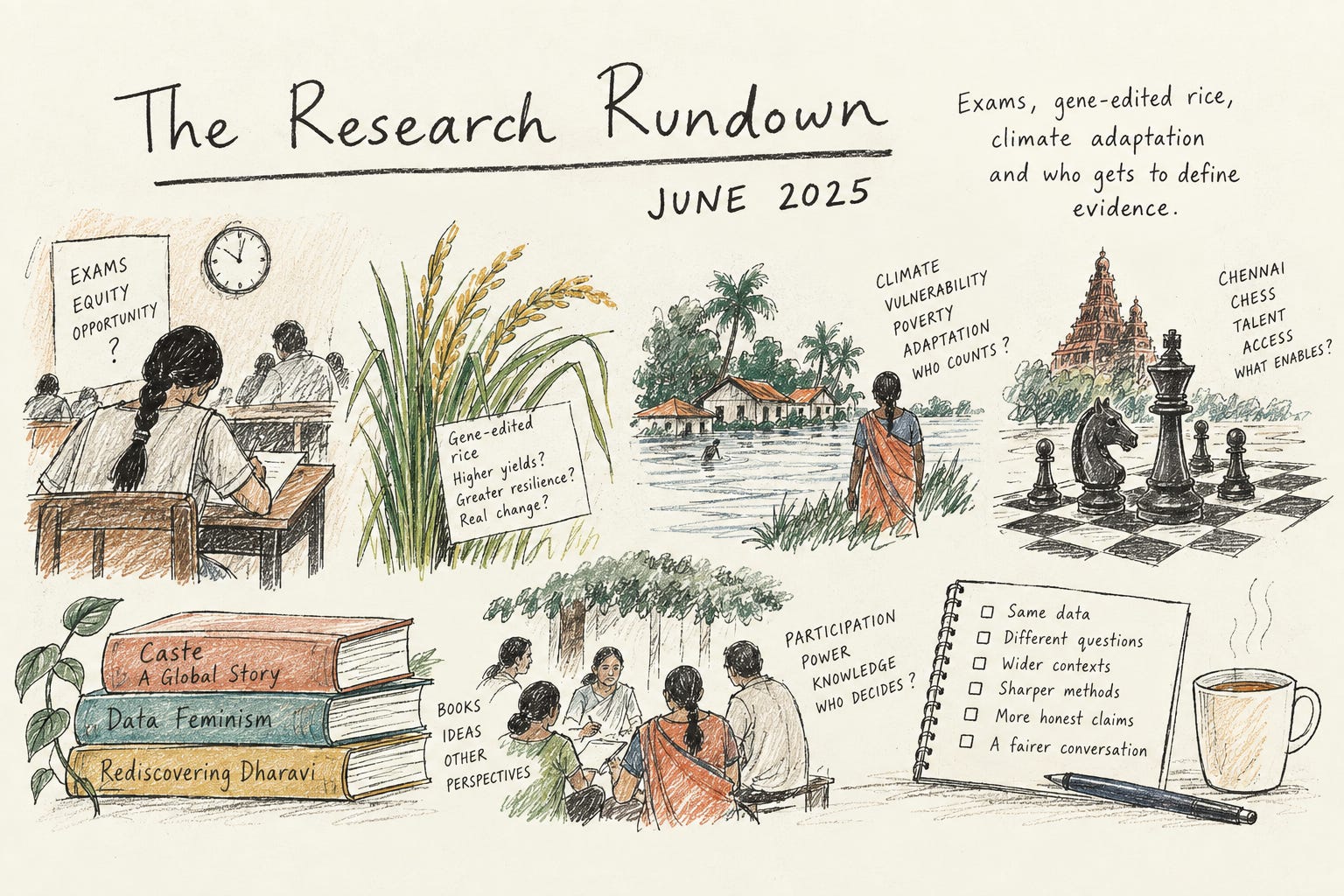
Dear Readers,
This month’s reading kept returning to a question that sounds methodological and turns out to be political: who gets to define the problem?
India’s National Testing Agency can standardise an examination across millions of candidates, yet a power cut in one room can still alter a student’s result. Agricultural scientists can edit a rice genome with remarkable precision, while the eventual value of the crop will depend on soils, seed systems, prices and farmers’ decisions. Participatory research can redistribute authority inside a project. It can also acquire the vocabulary of participation while leaving control almost untouched.
The South Asian material is especially strong this month. There is new work from Tamil Nadu and Bangladesh, a useful argument about Elinor Ostrom and the commons, Chennai’s extraordinary chess ecosystem, and a new book that takes caste well beyond India’s borders.
In this issue
- Five things worth reading
- One story worth thinking with
- Researchers worth following
- A methods note on participation
- Two books
- Research praxis
- Disambiguation corner
- Funsies
Five things worth reading
India’s examination problem survived the reforms meant to fix it
A year after the 2024 NEET crisis triggered a government review of the National Testing Agency, students were still reporting serious failures across NEET, JEE and CUET.
Johanna Deeksha’s June investigation for Scroll documents power outages during NEET, rain entering examination rooms, delays caused by technical failures, errors in question papers and CUET retests after questions appeared outside the prescribed syllabus. The government-appointed Radhakrishnan committee had already recommended changes to NTA’s governance, staffing and remit. Several had been accepted. Problems persisted.
The strongest part of the piece is institutional. NTA sits at the centre of an enormous high-stakes examination system while outsourcing several operating functions. Students encounter a national system through particular rooms, invigilators, servers and electricity supplies.
Standardisation at the top does not guarantee standard conditions at the point where the test is taken.
Johanna Deeksha, “Why the National Testing Agency continues to fail students in India,” Scroll, 10 June 2025.
India’s first genome-edited rice varieties are interesting. The claims need separating.
India announced two genome-edited rice varieties in May: DRR Rice 100 (Kamala), derived from Samba Mahsuri, and Pusa DST Rice 1, derived from MTU 1010. Both use CRISPR-based editing without introducing foreign DNA.
The headline numbers are easy to muddle. ICAR reports a 19 per cent yield increase for DRR Rice 100. For Pusa DST Rice 1, reported yield gains range from 9.66 to 30.4 per cent in saline and alkaline soils, with potential production increases of up to 20 per cent. ICAR also projects lower irrigation demand and greenhouse-gas emissions.
Those are variety- and environment-specific claims. “Thirty per cent more rice with twenty per cent less water” is too neat a summary.
The next questions concern performance outside research trials, seed availability, farmer costs, varietal replacement and whether stress tolerance holds across farming environments. A biological result becomes a development outcome only after passing through institutions and markets.
Nature India:
https://doi.org/10.1038/d44151-025-00078-2
ICAR:
A Tamil Nadu project asks what participatory climate research changes inside a university
Devisha Sasidevan, Sunil Santha, Tristan McCowan and Sowmya Balasubramaniam examine a collaboration involving a seed-keepers’ collective in Tamil Nadu, university faculty and students. The work centres on heirloom seeds, climate adaptation and participatory action research.
The paper is reflective rather than an impact evaluation. Its empirical material comes from the authors’ involvement in the initiative, and many of its claims concern changes in relationships, learning and knowledge production. It therefore cannot establish that participatory action research produces better climate outcomes than alternative approaches.
That limitation does not make the paper uninteresting. The useful question is what happens when universities treat people outside the university as participants in inquiry rather than principally as sources of data.
The paper is strongest when it describes the tensions involved, including differences of power and privilege within communities themselves. “Community” is not a single actor.
Sasidevan, Devisha, Sunil D. Santha, Tristan McCowan and Sowmya Balasubramaniam. 2025. “Bridging the gap: participatory action research for climate change adaptation in rural India.” International Journal of Sustainability in Higher Education.
https://doi.org/10.1108/IJSHE-10-2024-0710
Open-access author version:
https://discovery.ucl.ac.uk/id/eprint/10212113/
In flood-prone Bangladesh, poverty and climate vulnerability overlap imperfectly
A 2025 study from Sirajganj, Bangladesh surveys 385 households across six flood-affected communities and combines a multidimensional poverty measure with a climate-vulnerability index constructed using principal-component analysis.
The result I found most useful is the mismatch between the two measures. About 23.9 per cent of households were both multidimensionally poor and highly climate-vulnerable. Another 26.75 per cent were classified as non-poor while remaining highly vulnerable. Poor households were also found among those with relatively low vulnerability.
This matters for targeting. Poverty status cannot simply substitute for climate exposure, and a climate-vulnerability index cannot substitute for poverty measurement.
There is a caution. Composite indices depend on indicator choice, weighting and cut-offs. PCA gives the weights a statistical basis, but it does not make the resulting categories natural facts. The classification should be treated as an analytical device.
Tasin Islam Himel, Md Zakir Hossain and Khan Rubayet Rahaman. 2025. “Unraveling climate change vulnerability and adaptation in flood-affected communities of northern Bangladesh: A multidimensional poverty perspective.” Environmental Development 54: 101135.
https://doi.org/10.1016/j.envdev.2025.101135
Elinor Ostrom solved one problem and left another open
Benjamin Selwyn’s June essay on Elinor Ostrom is an argument about the limits of a major body of economic thought rather than a new empirical paper.
Ostrom’s work demonstrated that common-pool resources do not inevitably require privatisation or central state control. Communities can create institutions that govern forests, fisheries, irrigation systems and other shared resources over long periods. Selwyn accepts that contribution and asks what drops out when the analysis treats markets and resource users without sustained attention to class power and histories of dispossession.
The critique is explicitly Marxian. Readers may disagree with parts of it. It is still useful because Ostrom’s work is frequently translated into a fairly frictionless policy formula: create the right local rules and cooperation follows.
Local institutions themselves contain inequalities. Land, capital, caste, political influence and market position affect who enters collective arrangements with what bargaining power.
Benjamin Selwyn, “The Economist Who Solved the Free-Rider Problem,” Developing Economics, 24 June 2025.
https://developingeconomics.org/2025/06/24/the-economist-who-solved-the-free-rider-problem/
One story worth thinking with
Why does Chennai produce so many chess champions?
Omkar Khandekar’s NPR report on Chennai’s chess ecosystem is delightful on its own terms. Tamil Nadu accounts for roughly a third of India’s grandmasters, and Chennai produced both Viswanathan Anand and Gukesh Dommaraju. Schools make space for training, clubs have multiplied, businesses sometimes support promising players, and an ecosystem of coaches has accumulated over decades.
There is also an access story inside it.
Much chess instruction remains English-heavy. Coaching, tournaments and travel require money and adult time. The report describes attempts to widen access, including Venkatesh Enumalai’s Tamil Chess Channel and low-cost coaching.
I would stop short of calling Chennai’s success a system of “systematic exclusion”, as the original version of this newsletter did. The reporting does not establish that claim.
It does give us a better question: when a place becomes exceptionally good at identifying and developing talent, which parts of the ecosystem can be made available to children without the same family resources?
NPR, 8 June 2025:
Researchers worth following
Richa Govil
Richa Govil is Vice Chancellor of Azim Premji University’s Bengaluru campus and works on agricultural livelihoods, women in agriculture, household nutrition, farmer producer organisations and social enterprises.
Her work with Annapurna Neti on Farmer Producer Companies is especially useful because the FPO debate is often dominated by programme counts. Their research asks harder questions about capitalisation, inclusion, viability and the institutional support producer collectives require.
Profile:
https://azimpremjiuniversity.edu.in/people/richa-govil
Farmer Producer Companies report:
Arjun Appadurai
Appadurai’s 2006 essay “The Right to Research” remains worth reading almost twenty years later.
His argument is that research should be understood as a general capacity for disciplined inquiry rather than an activity belonging exclusively to professional researchers. The paper draws on work with PUKAR in Mumbai and connects research capacity to democratic citizenship.
The formulation is useful. It should also make professional researchers uncomfortable in productive ways.
https://doi.org/10.1080/14767720600750696
Accessible copy:
https://docs.ufpr.br/~clarissa/pdfs/Research_AppaduraiA.pdf
Kalpana Sharma
Kalpana Sharma has spent decades writing about cities, development, gender and environment.
Rediscovering Dharavi remains particularly useful because it treats Dharavi as an economy and social world rather than reducing it to a visual shorthand for urban poverty.
https://www.penguin.co.in/book/rediscovering-dharavi/
A methods note
Participation is a design property, not a label
“Participatory research” covers a very wide range of arrangements.
In one project, participants may help refine a questionnaire. In another, community organisations may choose the research question. Elsewhere, residents may collect data while researchers retain control over analysis, publication and funding. All three can be described as participatory.
That makes the label surprisingly uninformative unless we ask where authority actually sits.
For any participatory project, I would want to know:
- Who chose the research question?
- Who decided what counted as evidence?
- Who controlled the budget?
- Who interpreted the findings?
- Who could disagree with the researchers?
- Who owns the data?
- Who decides where and how the work is published?
- What happens after the project ends?
Participation can improve research. It can reveal categories and causal stories an external team would miss. It can also impose substantial unpaid work on participants or reproduce local hierarchies.
The method is therefore not virtuous by definition.
A useful discussion of the distinctions between action research, participatory action research and community-based participatory action research:
And the Tamil Nadu paper above provides a current Indian case:
https://discovery.ucl.ac.uk/id/eprint/10212113/
Two books
Caste: A Global Story by Suraj Milind Yengde
Published in India in June 2025, Yengde’s new book pushes caste beyond the familiar frame of a social hierarchy contained within India. He follows caste and anti-caste politics across migration, empire and diaspora, from indentured labour in the Caribbean to contemporary South Asian communities in Britain, North America, Africa and the Gulf.
The comparative ambition is the interesting part. Yengde places Dalit politics alongside Black political thought and asks where analogies between caste and race are illuminating and where they break down. He also examines a question that receives less attention in Indian discussions of migration: what happens to caste when South Asians leave South Asia?
The book combines historical material, archival research and ethnographic work. It is an argument rather than a neutral survey, with Yengde making an explicit case for an international anti-caste politics.
That makes it worth reading alongside work that treats caste principally as an Indian administrative or electoral category. Mobility changes the institutional setting. It does not necessarily dissolve hierarchy.
Suraj Milind Yengde. 2025. Caste: A Global Story. Allen Lane.
Publisher page:
https://www.penguin.co.in/book/caste/
Data Feminism by Catherine D’Ignazio and Lauren F. Klein
This is from 2020 rather than new work. It stays on my reading list because its central question has aged well: how does power enter data collection, classification, analysis and presentation?
The book is particularly good on categories that appear technically neutral but carry political histories, invisible labour inside data systems, and the idea that data never arrive without context.
For researchers working with administrative data or large household surveys, the challenge is useful precisely because we can become accustomed to treating the variables we inherit as though the categories were self-evident.
The whole book is legally available online from MIT Press:
https://data-feminism.mitpress.mit.edu/
Research praxis
Start by separating three different kinds of participation
When planning a study, I find it useful to distinguish consultation, collaboration and control.
Consultation: researchers retain the design and ask participants for views.
Collaboration: researchers and participants make some substantive decisions together.
Community control: a community organisation or participant group holds decision-making authority over major parts of the research.
None of these is automatically the correct model.
A national labour-force survey cannot plausibly hand questionnaire design to every respondent. A village-level action-research project that claims to be community-led should probably give participants considerably more authority than a one-off focus group.
The choice should follow the purpose of the research.
The important thing is to describe the arrangement accurately. Calling consultation “co-production” creates the appearance of shared authority without demonstrating it.
One question usually exposes the difference:
Could participants change something the research team did not want changed?
If the answer is no, their role may still be useful. It probably is not control.
Disambiguation corner
Local knowledge and local consensus
They are different.
A community can possess detailed knowledge of an ecosystem while disagreeing sharply over what should be done with it.
Fishers may understand a coastal resource differently from tourism operators. Landless labourers may prefer an adaptation strategy that landowners oppose. Women and men inside the same household may face different costs from the same intervention.
Invoking “community knowledge” therefore does not resolve questions of representation.
The useful question is whose knowledge is being elicited, whose is missing and how disagreement enters the analysis.
Representation and authority
Having members of an affected group in a research process gives that group representation.
Authority concerns whether they can affect decisions.
A steering committee may be socially diverse while all major decisions remain with the funder or principal investigator.
Count both.
Funsies
Researcher: “This is a participatory workshop.”
Participant: “What are we deciding?”
Researcher: “The colour of the sticky notes.”
An uncomfortable number of project designs have entered the chat.
Closing note
This edition started life under the heading “Decolonizing Data, Centering Voices”. I still care about the question behind that phrase. I am less interested in the slogan.
The papers this month suggest a harder approach.
Ask where authority sits.
The NTA case shows what happens when national standardisation meets unequal local conditions. Genome editing shows the distance between technical performance and farmer outcomes. Participatory research asks researchers to redistribute some authority over knowledge production. The Bangladesh study shows why categories such as “poor” and “climate-vulnerable” cannot simply be treated as interchangeable. Yengde’s book adds another version of the same problem: social categories do not stop at national borders simply because our datasets often do.
None of this requires romanticising local knowledge or distrusting expertise.
It requires being precise about whose evidence answers which question.
That seems a better place to end.
See you next time.
Varna Sri Raman Editor, The Research Rundown