Good Read - Why Economists Don’t Listen: Tales From an Anthropology Spy in Economic
2026-09-07. Published at https://varna.substack.com/p/good-read-why-economists-dont-listen. This file is a generated copy; the Substack post is the original.
For our new series Good Reads, I’d like to begin with this beautiful article:
Link: indevelopmentmag.com/why-economists-dont-listen/
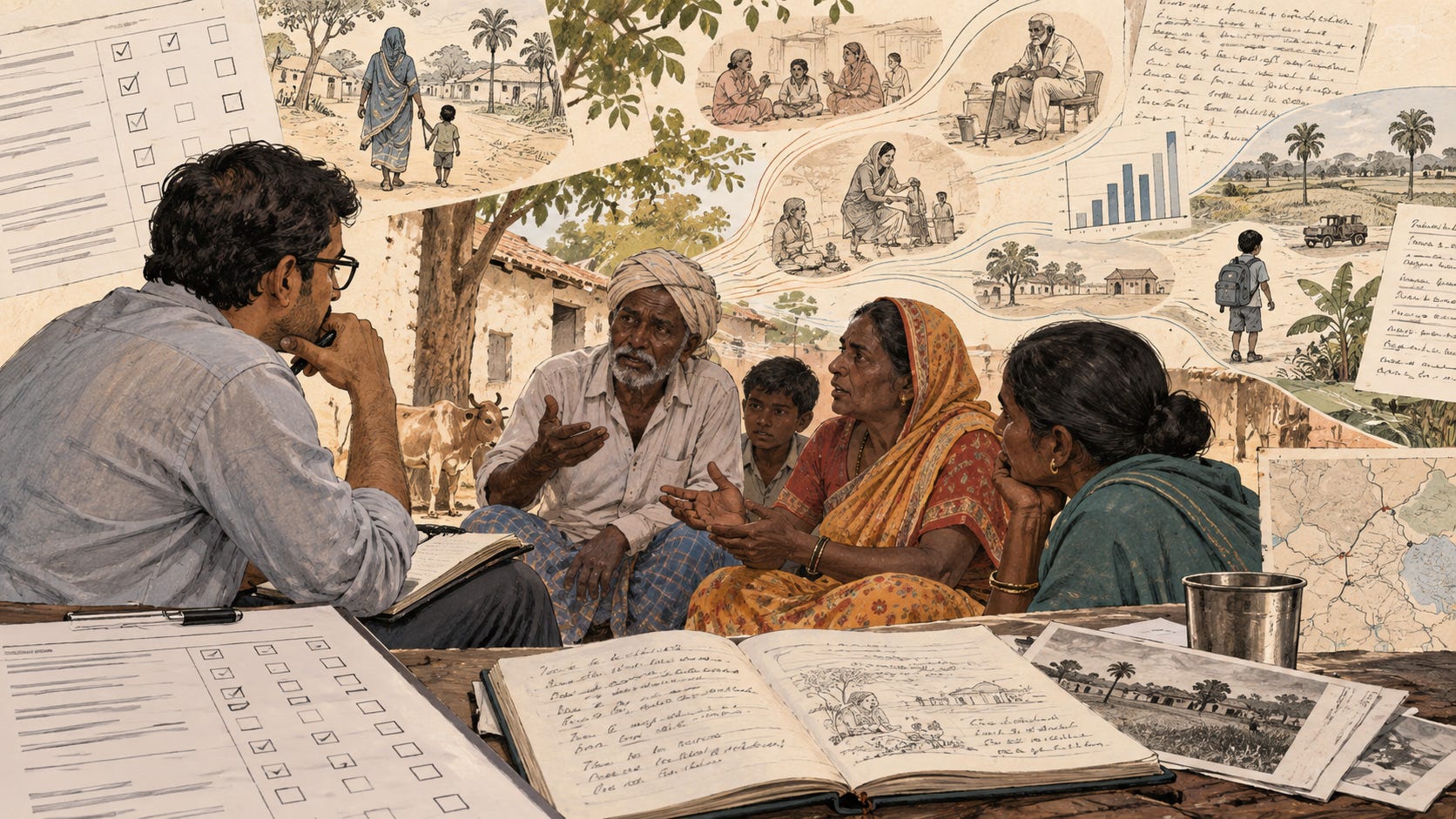
Rao begins with a failure of measurement. In a Karnataka village in 1993, he was administering a conventional household survey when a woman was dragged away by her husband for failing to cook lunch. The questionnaire had no place to record what he had just witnessed. A week of staying in the village and talking with women eventually produced evidence about domestic violence that the original instrument had been incapable of seeing. Rao and his colleagues rewrote the survey, and the episode became the starting point for later mixed-methods work on dowry violence and domestic abuse. (In Development)
The essay develops that episode into a larger criticism of development economics. Rao argues that the discipline’s pursuit of cleaner identification has increased its distance from the people it studies. Surveys and experiments can estimate effects with considerable precision, while the mechanisms, meanings and experiences behind those effects often remain thinly observed. His alternative is methodological pluralism grounded in field engagement: open-ended interviews, ethnography, narrative data, attention to process, and greater involvement of respondents in deciding what researchers should ask. (In Development)
The most persuasive parts are the concrete examples. Rao describes a participatory study in which tribal communities designed their own questions and produced a 32,000-household census. Only 17 per cent of those questions overlapped with the standard National Sample Survey. He also revisits a randomized trial of participatory planning in Karnataka where the headline result was null. Embedded ethnography showed that implementation quality, administrative transfers and caste inequality had shaped the outcome in ways the treatment effect alone could not explain. (In Development)
I am less persuaded by the broad disciplinary diagnosis. Development economics is more varied than the essay sometimes allows, and qualitative work can suffer from its own problems of inference, researcher positionality and selective interpretation. Rao’s stronger claim is methodological: the research question should determine the evidence we collect, and some questions become distorted when the instrument defines the world before researchers have spent enough time understanding it.
The final section on AI is particularly worth reading. Rao sees real promise in using language models to code qualitative material at scale, while warning that models trained poorly on Bengali or Rohingya text can generate biases that are harder to inspect than errors in a conventional survey. His rule is sensible: computational tools can extend the researcher’s reach; they cannot replace familiarity with people, transcripts and context. (In Development)